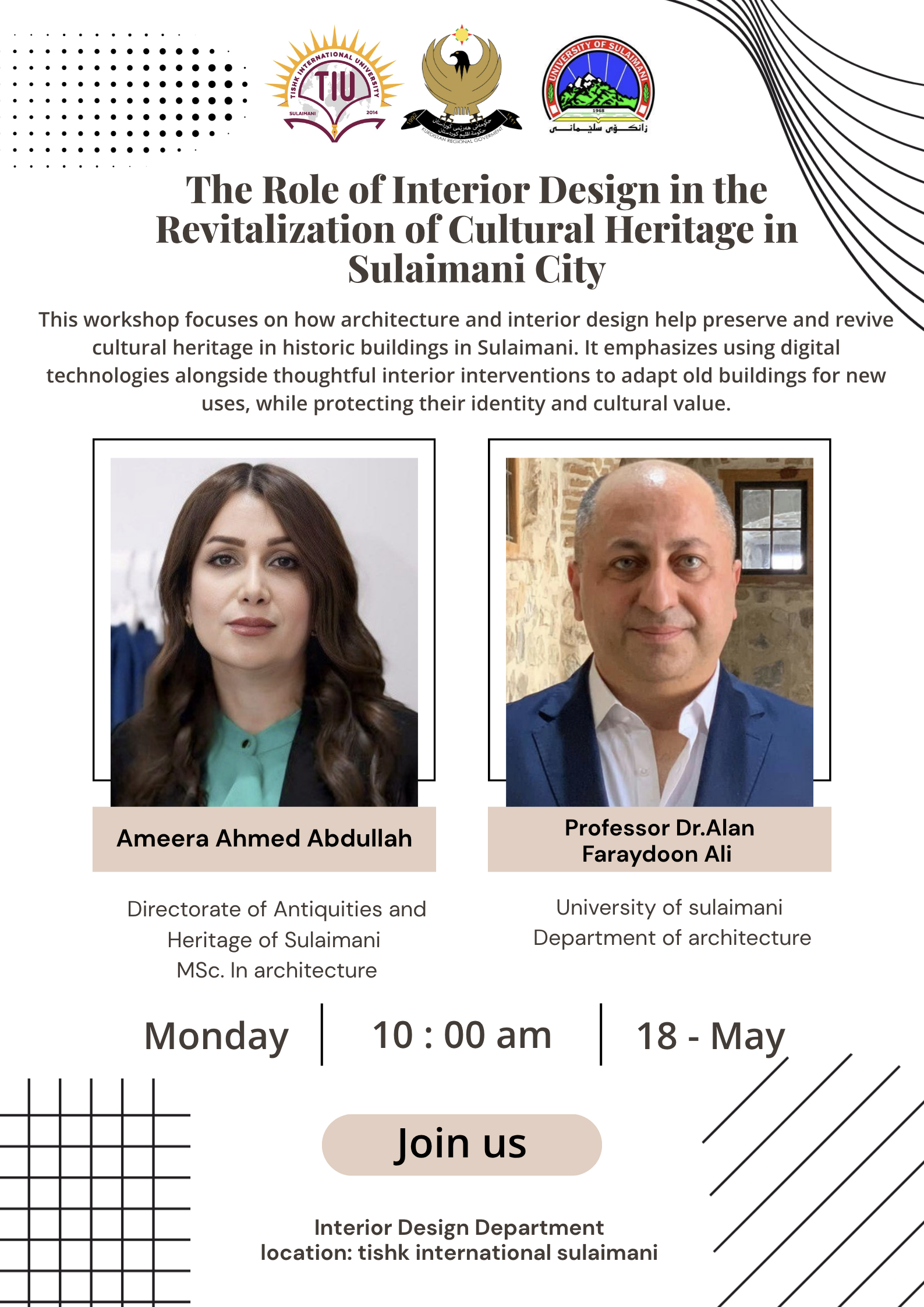
Date: 18 May 2026
This workshop explores the important role of interior design and architecture in preserving, revitalizing, and reinterpreting the cultural heritage of Sulaimani City. It focuses on how contemporary design approaches, adaptive reuse strategies, and digital technologies can contribute to the conservation of historical buildings while maintaining their architectural character, cultural identity, and social significance.
The workshop is structured into two main parts:
Part 1: Academic Insights and Heritage Research
The first part presents academic perspectives on the preservation and rehabilitation of historical buildings in Sulaimani City. It includes an evaluation of heritage buildings presented by Ameera Ahmed from DIHS, focusing on their architectural characteristics, cultural value, current conditions, and the challenges associated with their preservation.
The session also includes a discussion on digital reconstruction and rehabilitation of historical buildings in Sulaimani, based on a published study by Dr. Alan Faraydoon. This part highlights the potential of digital technologies, documentation methods, and digital reconstruction techniques to support the understanding, conservation, and rehabilitation of historic architectural environments. It emphasizes how technology can assist designers and researchers in documenting existing conditions and developing appropriate interventions while respecting the original identity of heritage buildings.
Part 2: Student Projects and Practical Applications
The second part of the workshop presents selected student graduation projects that demonstrate practical applications of interior design and adaptive reuse within culturally significant sites in Sulaimani City.
The showcased projects include the interior redesign and adaptive reuse of Saray Sulaimani and Cinema Dlshad, demonstrating how historical and culturally significant buildings can be transformed to accommodate contemporary functions while preserving their architectural character and cultural meaning.
Through these projects, students explore the relationship between existing historical structures and new design interventions, addressing issues such as spatial transformation, functionality, user experience, material selection, cultural identity, and the preservation of architectural elements. The projects demonstrate how adaptive reuse can provide new life to heritage buildings rather than allowing them to become neglected or disconnected from contemporary urban life.
Workshop Aim and Audience
The workshop is designed for interior design and architecture students, academics, researchers, and professionals interested in cultural heritage, conservation, adaptive reuse, and contemporary design.
Its main aim is to bridge academic theory with practical design applications, increase awareness of the cultural and architectural heritage of Sulaimani City, and encourage students and designers to approach historical buildings as valuable resources for contemporary architectural development.
The workshop also promotes innovative design solutions that balance heritage preservation with modern requirements, demonstrating that architecture and interior design can contribute not only to the physical conservation of historic buildings but also to the continuation of their cultural, educational, and social roles within the city.
Overall, the workshop emphasizes the importance of protecting Sulaimani City’s architectural heritage while creating opportunities for these spaces to remain active, meaningful, and relevant to future generations.